
Reviewed · WORKSHOPS
Tenerife Landscape Photography Workshop 5 hours
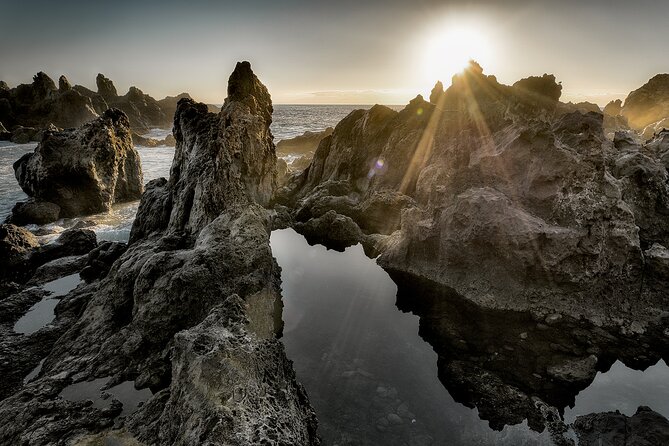
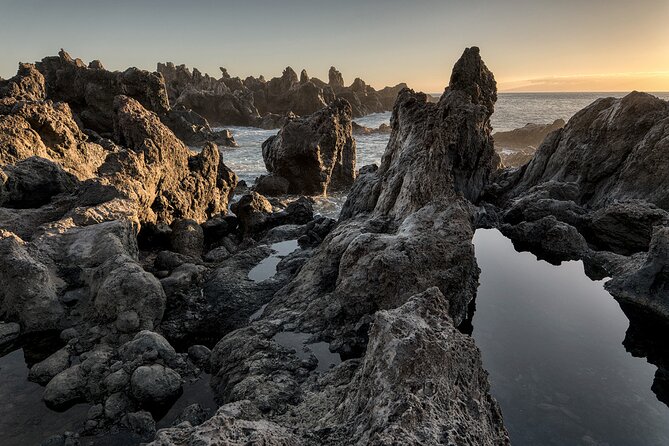
Charco del Diablo gives this workshop its edge: you are not simply pointed at a pretty view and told to press the shutter. You work with black volcanic rock, restless Atlantic water, and changing sunset light, while the instructor helps you decide why one composition works better than another. The south-coast option begins near Punta Negra, with a northern alternative at La Guanca and Charco del Viento.
I like the one-to-one feel of a private group and the clear focus on camera decisions rather than sightseeing chatter. I also like that the five hours are long enough to practice manual exposure properly, including the real effect of changing aperture and shutter speed. The main thing to consider is that lunch is not included, hotel pickup costs extra, and the outing depends on good weather.
In This Review
- Key points at a glance
- Why this Tenerife workshop is about decisions, not snapshots
- Starting at Punta Negra in Tenerife’s south
- Charco del Diablo and the appeal of volcanic details
- The northern alternative at La Guanca and Charco del Viento
- What the five hours of coaching actually cover
- Why a private group can be worth the price
- Getting there and arranging pickup
- Who will get the most from this experience
- Instructor style and what you should bring
- Booking flexibility and weather concerns
- Should you book the Tenerife photography workshop?
- FAQ
- How long is the Tenerife photography workshop?
- What time does the activity start?
- Where does the workshop meet?
- Where does the activity finish?
- Which photography locations are included?
- Is hotel pickup available?
- Is lunch included?
- Can I cancel for a full refund?
Key points at a glance
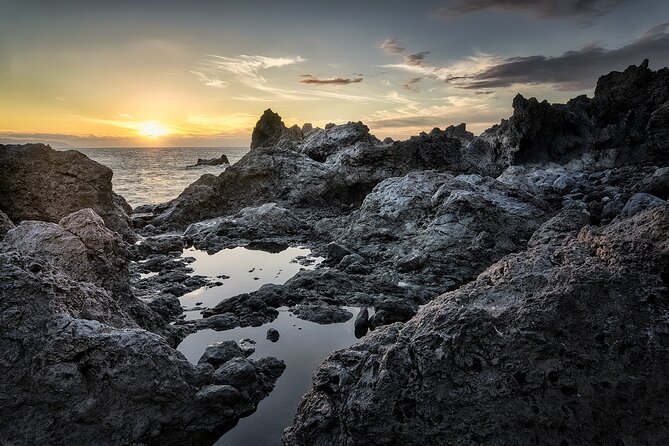
- Volcanic coast at sunset: Photograph lava formations and Atlantic water at Charco del Diablo or Charco del Viento.
- Practical camera coaching: Work directly on composition, aperture, shutter speed, and full manual control.
- Private experience: Only your group takes part, allowing the instructor to adjust the session to your level.
- Five hours from 2 pm: The timing is designed to reach the coast during the softer evening light.
- South or north option: Punta Negra is the southern setting, while La Guanca and Charco del Viento offer a northern alternative.
- Flexible pickup: Hotel or other pickup can be arranged for an extra charge, while the standard meeting point is in Santiago del Teide.
Why this Tenerife workshop is about decisions, not snapshots
Many photography outings give you a scenic place and a short list of camera settings. This one is more useful if you want to understand what those settings do. The instructor, identified as Detlef in the experience details, works through the choices behind an image: how you frame the rock, how much movement you allow in the water, and how an aperture change affects the final result.
That practical approach matters. You can copy a setting from a video, but copying does not always teach you when to use it. Here, you are encouraged to make a choice, look at the result, and adjust. The five-hour format gives you time for that process instead of rushing from one viewpoint to the next.
The experience is private, so you are not trying to keep up with a large group. If you already know the basics, you can spend more time refining composition. If manual mode still feels uncertain, you can work through it step by step.
More photo sessions on Tenerife:
- Tenerife: Kayak Safari and Sea Turtle Snorkeling with Photos
★ 4.5 · 2,028 reviews - Los Cristianos: Kayak and Snorkel with Turtles and Photos
★ 4.5 · 1,181 reviews - Tenerife: Surfing Lesson for All Levels, Photos included
★ 4.9 · 861 reviews
Starting at Punta Negra in Tenerife’s south
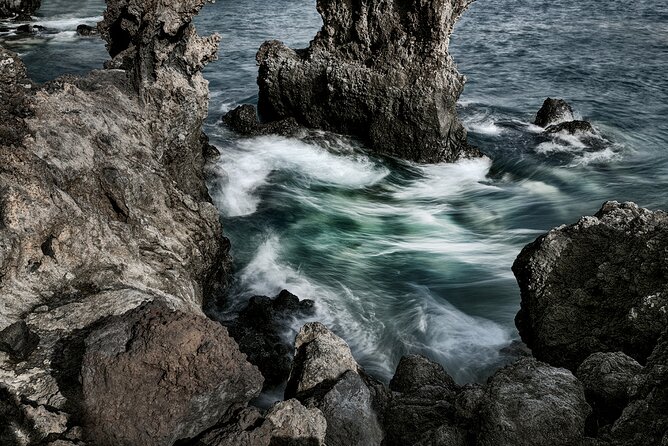
The standard meeting point is C. Punta Negra, 24, 38683 Santiago del Teide. The session starts at 2 pm and finishes back at the meeting point. From there, the southern route leads toward the Punta Negra area and Charco del Diablo, also called Charco El Diablo.
This is a place shaped by Tenerife’s volcanic past. Lava forms rough, dark edges around pools and channels, creating strong lines for a photograph. The Atlantic adds movement and sound, even when the sea itself is not especially rough. You have plenty to work with: hard rock against soft water, small pools beside open sea, and the low evening sun changing the color and contrast of the scene.
I would expect the instructor to use the location as a series of small photography lessons rather than one fixed stop. You might first work on finding a clean frame, then adjust your shutter speed to show water movement, then change your aperture to control how much of the scene appears sharp.
The coastal rock is also a useful test of composition. Dark lava can swallow detail in shadow, while a bright sky can pull attention away from the foreground. That makes exposure decisions important. You are not just photographing a pretty sunset. You are learning how to balance several difficult tones in one image.
Charco del Diablo and the appeal of volcanic details
Charco del Diablo is described as a pure lava setting, with natural formations that offer many photo subjects. The value here is variety. You can look for a broad coastal frame, a tighter study of rock and water, or a pattern created by the lava arms and pools.
The place should suit photographers who enjoy working slowly. A single formation can look very different when you change your position by a small amount. Move too far, and the rock may lose its shape. Stay too wide, and the main subject may get lost among the dark surfaces.
This is where composition coaching can make a real difference. The instructor’s role is not simply to identify the best viewpoint. It is to ask you to think about why you are placing the horizon, rock edge, or pool in a particular part of the frame. One of the strongest points from the experience is that the coaching helps you look at photography differently, not just operate the camera.
For sunset work, timing also matters. The workshop begins well before sunset, giving you time to become familiar with the site and make deliberate adjustments as the light changes. I like that setup because the best image may come before the sun disappears, when the lava still has some visible texture and the sky is not yet too bright or too dark.
The northern alternative at La Guanca and Charco del Viento
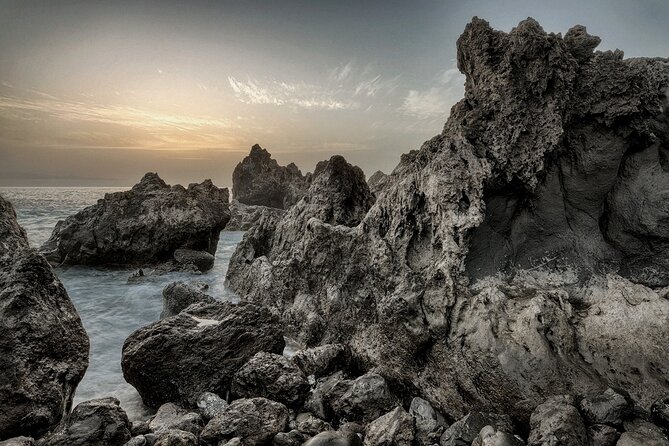
If the plan is arranged in the north, the setting changes to La Guanca and Charco del Viento. This alternative is described as a place of color and strong Atlantic movement, where water pushes between arms of lava.
Charco del Viento offers a different kind of subject from the southern option. Instead of concentrating only on rock pools, you can watch how the water enters the spaces between the volcanic formations. Even weak waves can create motion, reflections, and changing patterns.
That makes shutter speed especially useful. A faster setting can preserve the shape of a breaking wave, while a slower one can soften movement into a smoother effect. The point is not that one approach is always better. The point is that you can try both and see how each changes the feeling of the photograph.
The northern site is also presented as a good sunset location. As with Charco del Diablo, the exact conditions will depend on the day. The weather policy is clear: if poor weather prevents the activity, you can be offered another date or a full refund. This is worth keeping in mind because the workshop depends on outdoor light and coastal conditions.
The two route choices give the experience some useful flexibility, but you should confirm which location is planned for your date. The information allows for an alternative, yet it does not promise that every booking includes both the south and north locations.
More workshops and classes on Tenerife:
- Group Surfing Lesson at Playa de las Américas, Tenerife
★ 5.0 · 1,072 reviews - Playa de las Américas: Private or Small-Group Surf Lesson
★ 4.8 · 980 reviews - Group Surf Lessons
★ 5.0 · 310 reviews - Private Surfing Lesson at Playa de las Américas
★ 5.0 · 167 reviews
What the five hours of coaching actually cover
The most valuable part of this experience is the hands-on instruction. The coaching focuses on composition and camera controls, with particular attention to aperture and shutter speed. You work toward using the camera fully in manual mode rather than relying on automatic settings.
Aperture affects how much of the scene appears sharp and also changes the amount of light entering the camera. At a rocky coast, that can help you decide whether the foreground texture or the distant water should receive more attention.
Shutter speed controls the way movement is recorded. At Charco del Diablo or Charco del Viento, the sea gives you an immediate subject. You can compare a crisp wave with a softened flow and see the result on your own camera.
The instructor also explains the steps clearly and encourages you while you work. That combination is important. Technical advice can become frustrating if it arrives as a string of unexplained numbers. Here, the emphasis is on understanding what each change does to the image.
One participant described moving from uncertainty with manual controls to much greater confidence in only five hours. I would not treat that as a guaranteed result, since skill levels and practice habits differ. Still, it gives you a useful idea of the workshop’s teaching style: direct, encouraging, and built around making your own decisions.
Why a private group can be worth the price
At $118.29 per person, the price is not simply paying for access to the coast. You are paying for five hours of private instruction, location guidance, and time to practice. For someone serious about improving, that can be better value than a short group walk with limited camera help.
The private format is especially useful if people in your group have different skill levels. You do not have to wait while a large class catches up, and the instructor can focus on the controls that cause you trouble. A beginner may need help understanding exposure, while a more experienced photographer may want to refine framing and timing.
The price is harder to justify if you mainly want transport to a scenic viewpoint or a quick sunset photo. You can find volcanic coast and evening light in many places around Tenerife without booking a workshop. The added value comes from the teaching, so bring a camera you want to understand and be ready to practice.
Drinking water and soda are included. Lunch is not, so plan to eat beforehand or bring what you need. The session begins at 2 pm and lasts about five hours, which places the main photography period in the afternoon and evening. The exact sunset experience will vary with the date and weather.
Getting there and arranging pickup
The listed meeting point is in Santiago del Teide, at C. Punta Negra, 24. The activity ends at that same meeting point, so you should plan your return from there unless separate arrangements are made.
Pickup from a hotel or another location is available on request for an additional cost. Workshop days, meeting points, and pickup times can also be changed individually. That flexibility may help if you are staying elsewhere in Tenerife, but do not assume hotel pickup is part of the $118.29 price.
I would confirm the final meeting details before setting out. The information gives a standard start time of 2 pm, while also allowing individual changes. A clear pickup plan matters more here than on a simple central walking tour, since the photo locations are on the coast and the activity finishes after several hours.
Who will get the most from this experience
This workshop is a good fit if you want to improve your photography during a Tenerife holiday without giving up a full day. The five-hour length gives you a focused block of practice, and the private format lets the instructor meet you at your current level.
It should suit you particularly well if:
- You want to move beyond automatic or semi-automatic settings.
- You are unsure how aperture and shutter speed affect a final image.
- You like volcanic rock, sea movement, and sunset light as photo subjects.
- You learn best by making changes and seeing the result immediately.
- You prefer individual coaching to a large class.
- You want a private activity for your own group.
It may not be the right choice if you want a general sightseeing trip, a meal, or guaranteed sunshine. The focus is photography, and the quality of the session depends partly on coastal weather and available light.
You should also be comfortable working around natural lava formations. The supplied details do not describe the walking surface, route difficulty, or equipment provided, so ask the provider about those points if they affect your plans. The activity states that most people can participate, but it does not provide a detailed accessibility description.
Instructor style and what you should bring
The teaching style is encouraging and explanatory. Detlef is described as someone who gets you thinking about composition and the controls that create an image, rather than handing you a fixed recipe.
I would arrive with a camera you know how to operate at a basic level, even if manual mode is new to you. The workshop is built around practice, so it helps if you can already turn the camera on, review an image, and change the main settings. Bring enough battery and memory for several hours of shooting, although the supplied information does not specify equipment or accessories provided by the operator.
Wear clothing suitable for an outdoor coast and expect the weather to matter. No special clothing list is provided, so use your own judgment for the conditions on your date. Water and soda are included, but lunch is not.
Booking flexibility and weather concerns
Confirmation is received at the time of booking. You can cancel for a full refund if you do so at least 24 hours before the 2 pm start time. Cancellations made within 24 hours are not refunded, and changes inside that period are not accepted.
The local time controls the cutoff. If poor weather cancels the activity, you are offered another date or a full refund. This is a reasonable policy for a workshop that relies on outdoor coastal conditions, though it means you should keep some flexibility in your holiday schedule if possible.
The experience provider is D.W. SCHMALOW-Gallery. Since the route and pickup details can be adjusted individually, confirm the exact plan, meeting point, and any extra transport charge before the day.
Should you book the Tenerife photography workshop?
Book it if you want instruction, not just scenery. The strongest reason to choose this experience is the chance to spend five focused hours learning how composition, aperture, and shutter speed work together at dramatic volcanic coast locations.
I especially like the private format, the sunset timing, and the emphasis on helping you make your own camera decisions. At $118.29 per person, it offers fair value for a serious photography learner, though less value for someone who only wants a ride to a viewpoint.
Choose it with realistic expectations: the session depends on good weather, lunch is your responsibility, and pickup may cost extra. If those details suit you, Charco del Diablo or Charco del Viento can provide the raw material, while Detlef’s coaching helps you turn it into stronger photographs.
FAQ
How long is the Tenerife photography workshop?
The workshop lasts approximately five hours.
What time does the activity start?
The listed start time is 2 pm.
Where does the workshop meet?
The standard meeting point is C. Punta Negra, 24, 38683 Santiago del Teide, Santa Cruz de Tenerife, Spain.
Where does the activity finish?
The activity ends back at the meeting point.
Which photography locations are included?
The southern option includes Punta Negra and Charco del Diablo, also called Charco El Diablo. The northern alternative includes La Guanca and Charco del Viento.
Is hotel pickup available?
Pickup from a hotel or another location is available on request for an additional cost. Meeting points and pickup times can be changed individually.
Is lunch included?
No. Lunch is at your own expense. Soda and drinking water are included.
Can I cancel for a full refund?
Yes. You must cancel at least 24 hours before the experience start time for a full refund. If poor weather cancels the activity, you are offered another date or a full refund.
Recently added around Tenerife
- Los Cristianos: Stand Up Paddle Board Lesson★ 5.0 · 3 reviews
- Radazul: Family-Friendly Snorkeling Tour★ 5.0 · 3 reviews
- 3h Whale Watching Private tour Beneteau Oceanis 440★ 5.0 · 3 reviews
- Go West – VIP Private Tour in Tenerife to Masca, Garachico and Icod★ 5.0 · 3 reviews
- Tenerife Exclusive & Private Gastronomic, Sunset-Stargazing★ 5.0 · 3 reviews
- Whale & Dolphin Watching With Mustcat Virgin Coast Trip On a Large Catamaran★ 4.0 · 3 reviews
- Eco Adapted Diving in Tenerife★ 5.0 · 3 reviews
- Professional Cocktail Masterclass★ 4.5 · 3 reviews
Workshops, compared.
Group Surfing Lesson at Playa de las Américas, Tenerife
Read our review →
Private Surfing Lesson at Playa de las Américas
Read our review →
Mojo Workshop Cooking Class in Ancient Canarian Village
Read our review →
Browse the lists this tour appears in